Friday Pickleball Aura vs Vatic Pro V-Sol Pro
Pickle's 5-axis score
Spec-grounded, quartile-ranked across the 322-paddle catalog. Diff highlighted when one paddle leads by 0.5+ points.
Reach vs. maneuverability
Friday Pickleball Aura trades a touch of maneuverability for more reach at the line; Vatic Pro V-Sol Pro is easier to whip around in hand fights.
Side-by-side specs
| Spec | Friday Pickleball Aura | Vatic Pro V-Sol Pro |
|---|---|---|
| Weight | 8–8 oz | 8–8.4 oz |
| Shape | Elongated | Multiple |
| Core thickness | 16mm | 16mm |
| Core material | EPP foam core with EVA foam and unique throat foam | Full foam core with EVA foam perimeter |
| Face material | Carbon fiber | Toray T700 raw carbon fiber |
| Handle length | 5.5" | 5.3" |
| Price | $129 | $109.99 |
Weight
Shape
Core thickness
Core material
Face material
Handle length
Price
What the spec differences mean
- Weight. Friday Pickleball Aura is listed at 8 oz; Vatic Pro V-Sol Pro at 8–8.4 oz. How paddle weights compare across our catalog
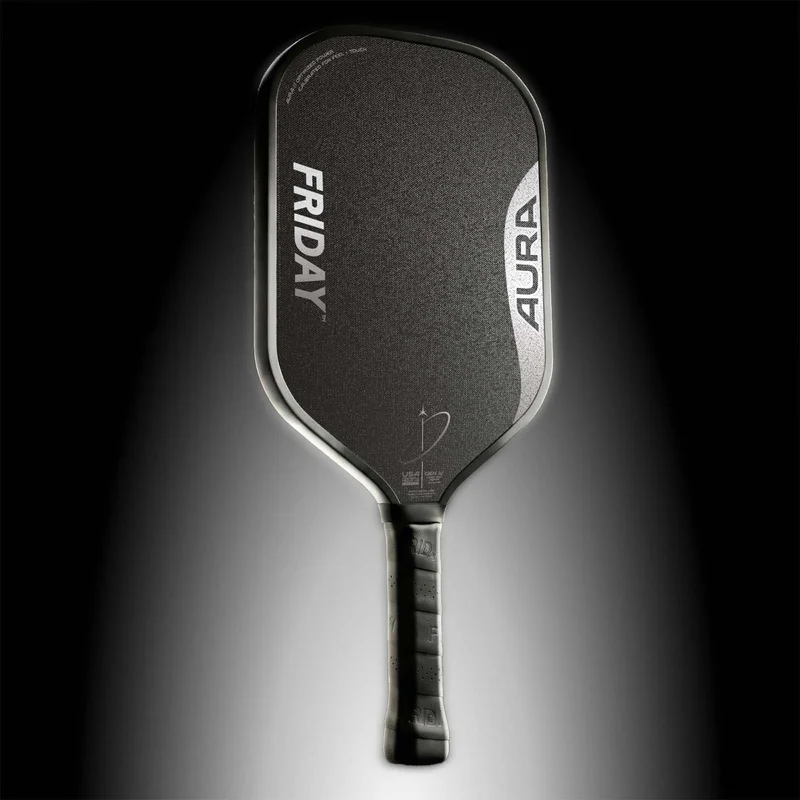
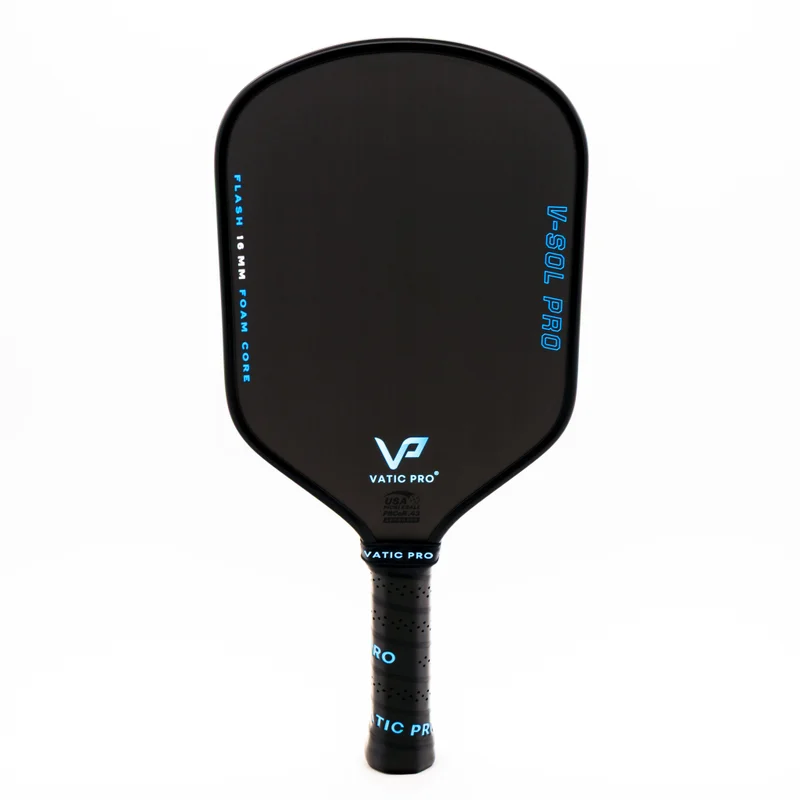
- Length and width. Friday Pickleball Aura measures 16.5" × 7.5"; Vatic Pro V-Sol Pro measures 16.25" × 7.5" (elongated vs multiple). The Friday Pickleball Aura is 0.25" longer. Paddle shapes and the size rule
- Handle length. Friday Pickleball Aura has a 5.5" handle; Vatic Pro V-Sol Pro has a 5.3" handle, so the Friday Pickleball Aura handle is 0.2" longer. What grip length changes
- Face material. Friday Pickleball Aura lists its face as Carbon fiber; Vatic Pro V-Sol Pro lists Toray T700 raw carbon fiber. Paddle face materials explained
- Core material. Friday Pickleball Aura lists its core as EPP foam core with EVA foam and unique throat foam; Vatic Pro V-Sol Pro lists Full foam core with EVA foam perimeter. Paddle core materials explained
Who each paddle is for
Friday Pickleball Aura
Best for 3.5+ players who prioritize control and reach who play with a balanced two-handed/one-handed mix. The elongated shape extends your reach at the kitchen line, the 16mm core gives you a soft touch window, and the face surface keeps spin honest without overdoing it.
Playing style: balanced
Vatic Pro V-Sol Pro
Best for 3.5+ players who prioritize control and reach who play with a balanced two-handed/one-handed mix. The standard shape rewards clean contact, the 16mm core gives you a soft touch window, and the raw carbon face bites on spin shots.
Playing style: power, control
Both are great. Pick by playstyle, not specs.
Pick the Friday Pickleball Aura if…
- ✓you prize control on resets and dinks
- ✓you like reach at the kitchen line
Pick the Vatic Pro V-Sol Pro if…
- ✓you swing through the ball
- ✓you prize control on resets and dinks
Friday Pickleball Aura vs Vatic Pro V-Sol Pro: the honest breakdown
Both are 16mm foam-core paddles near the same price, but they chase opposite feels. The $139.99 Friday Aura is the soft, touch-first pick: reviewers call it one of the plushest, most muted foam paddles on the market, tuned for control over raw power. The $109.99 Vatic Pro V-Sol Pro is the lighter, spinnier, more powerful budget pick, with a raw Toray T700 face that draws elite spin marks but a tighter sweet spot. The real question is not which is better but whether you want the Aura's soft placement game or the V-Sol Pro's light, spin-heavy power for about thirty dollars less.
Choose the Friday Pickleball Aura if…
- You want the softest, most muted foam feel for dinks, drops, and resets: reviewers at The Kitchen Pickle called the standard Aura the softest feeling foam paddle they had played to that point.
- Your game is control-first, a grindy defensive style that values placement over top-end power.
- You prefer a longer 16.5-inch elongated head for reach and leverage.
- You want a Gen-4 Friday foam build but do not need, or want to pay for, the power-tuned Aura Pro at $169.
- You are comfortable generating your own power rather than leaning on the paddle for it.
Choose the Vatic Pro V-Sol Pro if…
- You want to spend the least: at $109.99 it is about thirty dollars cheaper, and Pickleheads named it the best budget paddle of 2025.
- Spin and baseline power lead your game: the raw Toray T700 carbon face draws consistently high spin marks from reviewers.
- You want the quickest hands: reviewers describe it as one of the lightest 16mm paddles they have held, so it moves fast in exchanges.
- You do not mind a tighter sweet spot, or adding a little lead tape: reviewers commonly add a few grams at the 3 and 9 o'clock positions for stability.
- You want a choice of head shapes, since the V-Sol Pro is offered in multiple shapes rather than a single elongated build.
Both paddles drop the traditional polypropylene honeycomb for a foam core, so this is a foam-vs-foam matchup. The Aura runs an EPP foam core with EVA foam and a unique throat foam; reviewers describe rubber inserts and an Artificial Cartilage Foam section in the throat, a construction Friday tunes toward softness and feel rather than pop. The V-Sol Pro uses a full foam core inside an EVA perimeter ring under a Toray T700 raw-carbon face. Both list a 16mm core and start at 8 ounces, though the V-Sol Pro tops out around 8.4. The meaningful spec differences: the Aura is a longer 16.5 by 7.5 inch elongated paddle, while the V-Sol Pro is a slightly shorter 16.25 inches and comes in multiple shapes; and the V-Sol Pro's face is explicitly raw T700 carbon, the surface most associated with spin, where the Aura's face is listed simply as carbon fiber.
On the court the two feel like different tools. Reviewers describe the standard Aura as the softest, most muted foam paddle they had played, giving real confidence on dinks and drop shots but underperforming in fast hands battles against modern power paddles, which is the tradeoff its control-first design makes on purpose. The V-Sol Pro reads lighter and quicker, with spin reviewers rate near the top of its price class and easy baseline power, but a tighter sweet spot: several note instant feedback on mishits and add lead tape to the edges to steady it. That is the crux. The Aura is the plush, placement-oriented touch paddle; the V-Sol Pro is the light, spinny, more powerful one that rewards clean contact and a little tinkering.
This decision comes down to feel and playstyle, not simply price, and it is a different question from the Aura Pro matchup that many shoppers land on first. The standard Aura is not a power paddle: it deliberately trades pop for touch, which is why it sits below the Aura Pro at $139.99 rather than $169. If your game is soft, controlled, and built on placement, the Aura's muted feel is the draw. If your budget is tight, or spin and power lead your game, the V-Sol Pro is one of the best value paddles in this catalog and quicker in your hand for about thirty dollars less. Neither is a mistake; they are tuned for different players who happened to search for the same thing.
Frequently asked questions
Is the Friday Aura or the Vatic V-Sol Pro better for spin?
The Vatic V-Sol Pro has the spin edge. Its face is an explicit Toray T700 raw-carbon surface, the texture most associated with spin, and reviewers at Pickleheads rate its spin generation exceptionally high. The Friday Aura's face is listed as carbon fiber and the paddle is tuned toward soft control rather than spin, so if maximum spin is the goal the V-Sol Pro is the stronger pick.
What is the difference between the standard Friday Aura and the Aura Pro?
The standard Aura is the softer, control-oriented sibling. At $139.99 it uses an EPP foam core with EVA foam and a unique throat foam, and reviewers describe it as one of the softest, most muted foam paddles they have played, built for placement over raw power. The Aura Pro costs $169 and uses a power-tuned floating EPP core with an ElasTECH perimeter for more pop. If you want touch and control, the standard Aura is the pick; if you want power, the Aura Pro is the one to compare against the V-Sol Pro.
Which paddle is more forgiving on off-center hits?
They forgive differently. The Friday Aura's soft, muted foam gives confidence on touch shots like dinks and resets, but it gives up power in fast exchanges. The V-Sol Pro is one of the lightest 16mm paddles around, which makes it quick but less stable on mishits; reviewers report instant feedback outside the sweet spot and commonly add a few grams of lead tape at the 3 and 9 o'clock positions to steady it.
Is the Friday Aura worth about thirty dollars more than the V-Sol Pro?
It depends on what you value. At $139.99 versus $109.99, the Aura's premium buys a softer, more muted feel and a control-first game that reviewers praise for touch and placement. If you would rather spend less and want light, spin-heavy power, the V-Sol Pro delivers elite spin and strong value for about thirty dollars less, provided you do not mind a tighter sweet spot or adding a little lead tape.
Related comparisons
- Friday Pickleball Aura Pro vs Vatic Pro V-Sol Pro — The power-tuned Aura Pro against the same V-Sol Pro, if pop matters more than touch.
- Vatic Pro Prism Flash 16mm vs Vatic Pro V-Sol Pro — Vatic's foam V-Sol Pro against its raw-carbon Prism Flash, both under $150.
- Friday Pickleball Aura vs RPM Pickleball Q2 16mm Elongated — The soft Aura against another 16mm elongated foam-era paddle.
Sources
- Review: Breaking down the new Friday Aura and Aura Pro paddles — The Kitchen Pickle
- Friday Goes Foam — Tickle My Pickleball
- Vatic Pro V-SOL Pro - the best budget paddle of 2025 — Pickleheads
- Vatic V-Sol Review: Spin, Control & Value Under $100 — PickleTip
Specs and prices from our catalog. Construction and feel claims are attributed to the reviewers cited above; we do not run first-party playtests. Last updated 2026-07-23.
More matchups with the Friday Pickleball Aura
More matchups with the Vatic Pro V-Sol Pro
Affiliate disclosure: We may earn a commission at no extra cost to you.